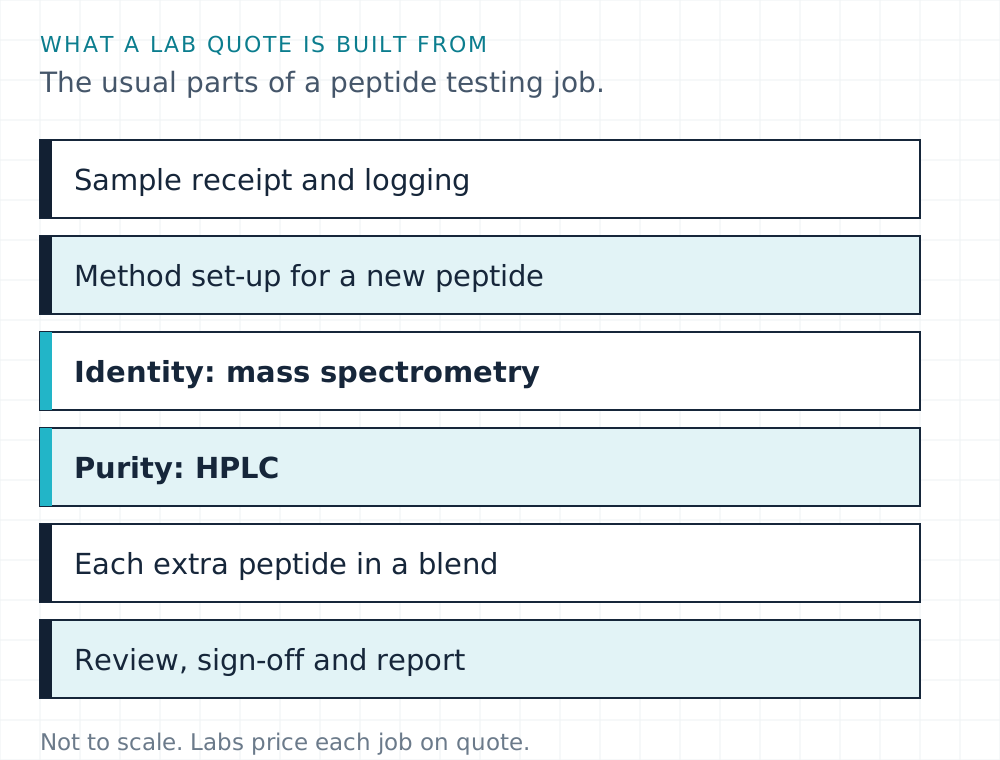
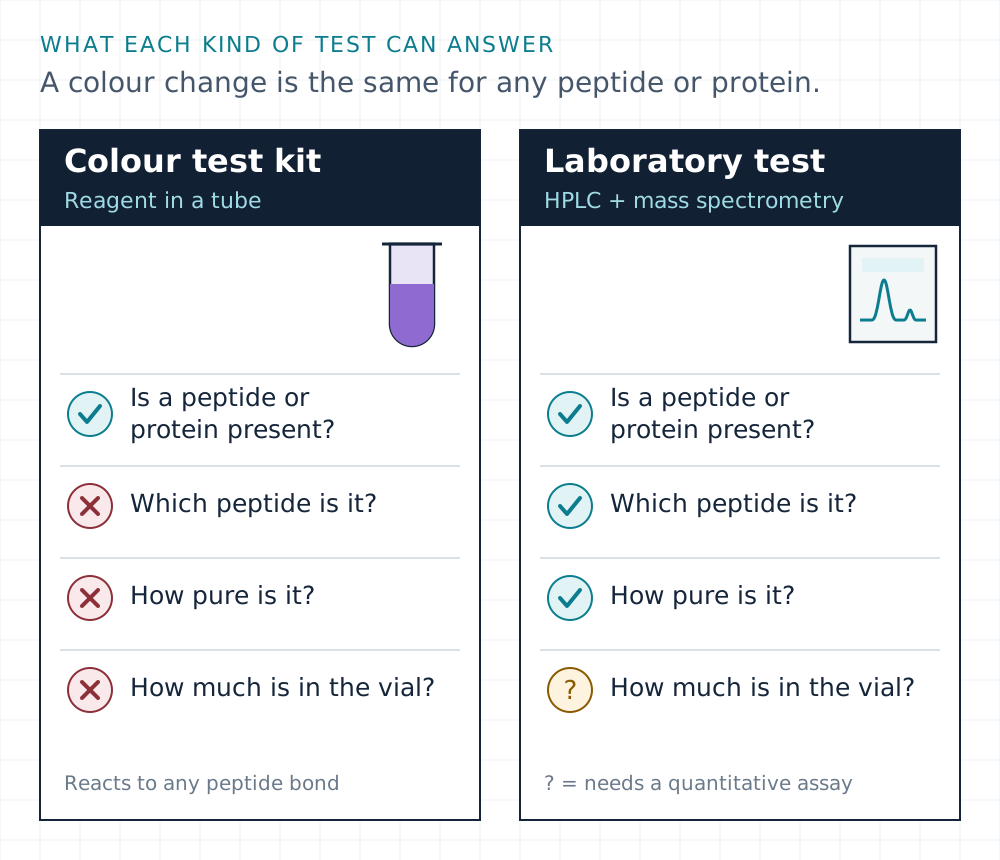
A home peptide test kit can, at most, show that something in a sample reacts like a peptide or protein. It cannot tell you which peptide is in the vial, how pure it is or how much is there; those answers need a laboratory, normally HPLC for purity and mass spectrometry for identity.
Searches for "peptide testing kit" and "peptide test kit" in Australia return three quite different things: colour reagent kits sold for at-home checks, ELISA kits sold to research labs, and laboratory services that test a sample you send in. This report explains what each measures, where each fits and why they are easy to confuse.
Three things sold as a peptide test kit
The words "test kit" cover products built for different users. When the desk recorded Google's first page for "peptide test kit" in Australia on 5 November 2026, it held at-home reagent kits, research ELISA kits from laboratory reagent suppliers and pages from testing labs. They are not interchangeable.
| Kit type | What you do | What it responds to | Built for |
|---|---|---|---|
| Colour reagent kit | Add drops of reagent to a small amount of sample and watch the colour | A chemical group shared by a whole class of compounds | Quick screening; gives a colour, not a name or a number |
| ELISA kit | Run a plate-based antibody assay with calibrators and a plate reader | One target molecule recognised by the kit's antibodies | Research and clinical labs measuring a protein or peptide in samples such as serum |
| Laboratory test | Send the sample to a lab that accepts it | Identity (mass) and purity (HPLC) of that sample | Anyone whose sample a lab will take |
What a colour test can show
Colour tests depend on a reaction between the reagent and a chemical group in the sample. The classic one for peptides is the biuret test, which detects peptide bonds: the reagent is normally pale blue and turns violet in the presence of proteins, which is why school biology courses use it to show that a food contains protein (LibreTexts biology lab manual).
That is also its limit. Every peptide and every protein is built from peptide bonds, so a violet colour says only that some peptide or protein is present. It cannot tell one peptide from another, separate a correctly made peptide from a truncated by-product, or say whether the vial holds one milligram or ten.
A case the TGA reported in September 2026 shows why this matters. A product sold as retatrutide contained no retatrutide; the TGA's testing found semaglutide instead (TGA safety alert). Both are peptides. A reagent that reacts to peptide bonds would have given the same colour for that vial as for the real thing.
What an ELISA kit is for
ELISA (enzyme-linked immunosorbent assay) kits use antibodies to capture a specific molecule and an enzyme reaction to produce a signal. In the common sandwich format, the sample is added to an antibody fixed to a plate, an enzyme-labelled antibody binds to the captured molecule, and the amount of coloured product is proportional to the concentration of the target in the sample (StatPearls, NCBI Bookshelf).
These kits are made for laboratories measuring how much of one known protein or peptide is present in a biological sample, with calibrators, controls and a plate reader. They are not designed to identify an unknown powder, confirm a sequence or report purity, so an ELISA result cannot answer the question most vial owners are asking.
What a laboratory test adds
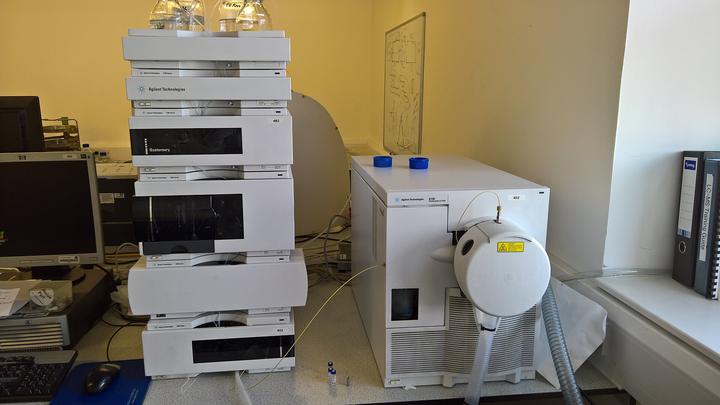
A lab test of a peptide vial normally combines two techniques. HPLC separates the dissolved sample into its components and records each as a peak; the share of total peak area under the main peak is reported as purity (our HPLC report explains how that number is produced). Mass spectrometry measures the mass of the molecule and compares it with the mass expected from the peptide's sequence. Proteomics International in Perth, for example, describes its intact-mass service as providing "a molecular mass for the protein or peptide of interest" for pure samples (Proteomics International).
Together those two answer the questions a kit cannot: is this the peptide on the label, and how much of what is in the vial is that peptide? They still leave some questions open. Sterility and bacterial endotoxin need separate microbiology tests, and the amount of peptide per vial needs a quantitative method.
Kit or lab: which answers your question?
| Question | Colour kit | ELISA kit | Lab (HPLC + MS) |
|---|---|---|---|
| Is any peptide or protein present? | Can indicate | Only its target molecule | Yes |
| Is it the peptide on the label? | No | Only if the kit targets that peptide | Yes, by mass spectrometry |
| How pure is it? | No | No | Yes, by HPLC |
| How much is in the vial? | No | For its target, against calibrators | Only with a quantitative method |
| Equipment needed | None | Plate reader and lab skills | The lab supplies it |
For most people asking whether a vial is what it claims to be, the answer sits in the right-hand column. If you decide to test, the practical step is finding a lab that will accept your sample; our step-by-step guide to sending a sample covers it. For one vial posted within Australia, Peptide Testing Australia runs a mail-in identity and purity test priced at A$575 per vial including GST.
Why a kit result can mislead
A positive colour change can feel like confirmation. It is not: it shows that the reagent found peptide bonds, which a mislabelled, underdosed or contaminated peptide product would also contain. A negative or very weak result is more telling, since it suggests little peptide is present, but it is still not a measurement.
The same logic applies to a supplier's certificate of analysis. It describes the batch the supplier says was tested, by a lab the supplier chose. It may be accurate, but it is not a test of the vial in front of you.
What a lab report should give you
If you go the lab route, the report is what you are paying for. Look for the lab's name and accreditation details, a unique report number, your sample ID, the methods (for example HPLC and LC-MS), results with units, the test dates and who authorised the report. NATA notes that reports from accredited labs must include the information required by the standard they are accredited to, and that results from subcontracted tests must be clearly identified (NATA, test reports explained). Our guide to accreditation and lab reports goes through each item.
Questions
Q.01Can I test peptides at home?
Only in a limited way. A colour reagent such as biuret can show that a peptide or protein is present, but not which peptide, how pure it is or how much is in the vial.
Q.02How accurate are peptide test kits?
Accuracy is the wrong frame for a colour kit: it gives a reaction, not a measurement. It responds to peptide bonds, which almost every peptide and protein shares.
Q.03Is an ELISA kit the same as a peptide purity test?
No. An ELISA measures how much of one target molecule is in a sample, against calibrators. It does not report purity or confirm a peptide's full identity.
Q.04What is the most reliable way to test a peptide?
A laboratory test that pairs HPLC for purity with mass spectrometry for identity, done by a lab that accepts your sample and issues a traceable report.