An accredited lab is one that an accreditation body, in Australia usually NATA, has assessed as technically competent for specific tests listed on its scope of accreditation, most often against the standard ISO/IEC 17025. Accreditation covers named methods rather than the whole business, so the useful questions are whether the peptide test you need is on the lab's scope and whether your report carries the NATA endorsement for it.
This report explains what NATA and ISO/IEC 17025 are, how other quality systems such as GMP and GLP differ, how to check a lab yourself and what a lab report should show.
What NATA is
NATA, the National Association of Testing Authorities, describes itself as Australia's leading accreditation organisation (NATA). It accredits laboratories and other bodies against national and international standards covering competency, quality assurance and continuous improvement (NATA standards). Different standards apply to different work: ISO/IEC 17025 for testing and calibration labs, ISO 15189 for human pathology, ISO/IEC 17020 for inspection bodies, and NATA also runs a Good Laboratory Practice (GLP) programme under the OECD Principles.
What ISO/IEC 17025 covers
NATA explains that in many countries ISO/IEC 17025 is the standard against which laboratories are accredited to be deemed technically competent for the methods and procedures listed on their scope of accreditation, and that in many cases suppliers and regulators will not accept results from a lab that is not accredited (NATA, ISO/IEC 17025). The key technical elements it lists are:
- validity and appropriateness of methods
- technical competency of staff
- traceability of measurements to national and international standards
- suitability, calibration and maintenance of equipment
- handling of test and calibration items
- quality control and assurance processes
- reporting of results
The current version is ISO/IEC 17025:2017, which replaced the 2005 edition.
Scope: the part most people miss
Accreditation is granted for the specific tests on a lab's scope, not for everything the lab does. NATA says accredited organisations are encouraged to put the NATA endorsement on reports for activities covered by their scope, and that use of the endorsement is not permitted on reports of testing outside it (NATA, test reports explained). A lab can hold NATA accreditation for, say, environmental testing and still run a peptide test that is not on its scope. That test may be done well, but the report cannot carry the endorsement for it.
Accreditation in the lab directory
The labs in our directory state their credentials in different ways, which shows how varied the paperwork is:
| Lab | What it states | Type |
|---|---|---|
| Proteomics International | ISO/IEC 17025, NATA 16838, since 2009; ISO 15189 (NATA/RCPA 21667); ISO 13485 | Accreditation number published |
| RASL | NATA accreditation no. 4105 | Accreditation number published |
| Eurofins (Sydney site) | NATA ISO/IEC 17025, TGA licence and GMP certificate, APVMA, FDA-registered cGMP | Listed, no numbers in page text |
| Chemika | TGA licence, GMP certificate, APVMA licence, FDA registration | Regulatory licences; no NATA number seen |
| Leeder Analytical, ChemCentre | Describe themselves as NATA-accredited | No number seen |
| Agilex Biolabs, SGS, BioAgilytix | FDA-inspected, GLP/GCP or GLP/cGMP, ISO/IEC 17025 environment | Quality systems, no NATA number seen |
| Flinders Analytical | Not stated | None stated |
Where a number is published, it can be checked. Where it is not, ask the lab for its accreditation number and the scope that covers your test.
GMP, GLP and TGA licences are different things
A TGA manufacturing licence and GMP certificate relate to the manufacture and quality control of therapeutic goods, which is why testing labs that work on medicines, such as Chemika and Eurofins, list them. Good Laboratory Practice (GLP) is a separate quality system, which NATA administers under the OECD Principles, and bioanalysis labs that support clinical trials, such as Agilex Biolabs, describe GLP- and GCP-compliant services. Each tells you something about a lab's quality system, but none of them is the same as ISO/IEC 17025 accreditation for a specific peptide test.
How to check a lab's accreditation
- Open NATA's search page. Search accredited organisations lets you search by business name, accreditation number or standard.
- Filter. Narrow by state and by status: the register shows whether an accreditation is active, suspended or withdrawn.
- Open the scope. Look for the technique (for example HPLC or LC-MS) and the kind of product or material that matches your test.
- Compare with your report. The accreditation number on the report should match, and the NATA endorsement should appear only for in-scope results.
What a lab report should show
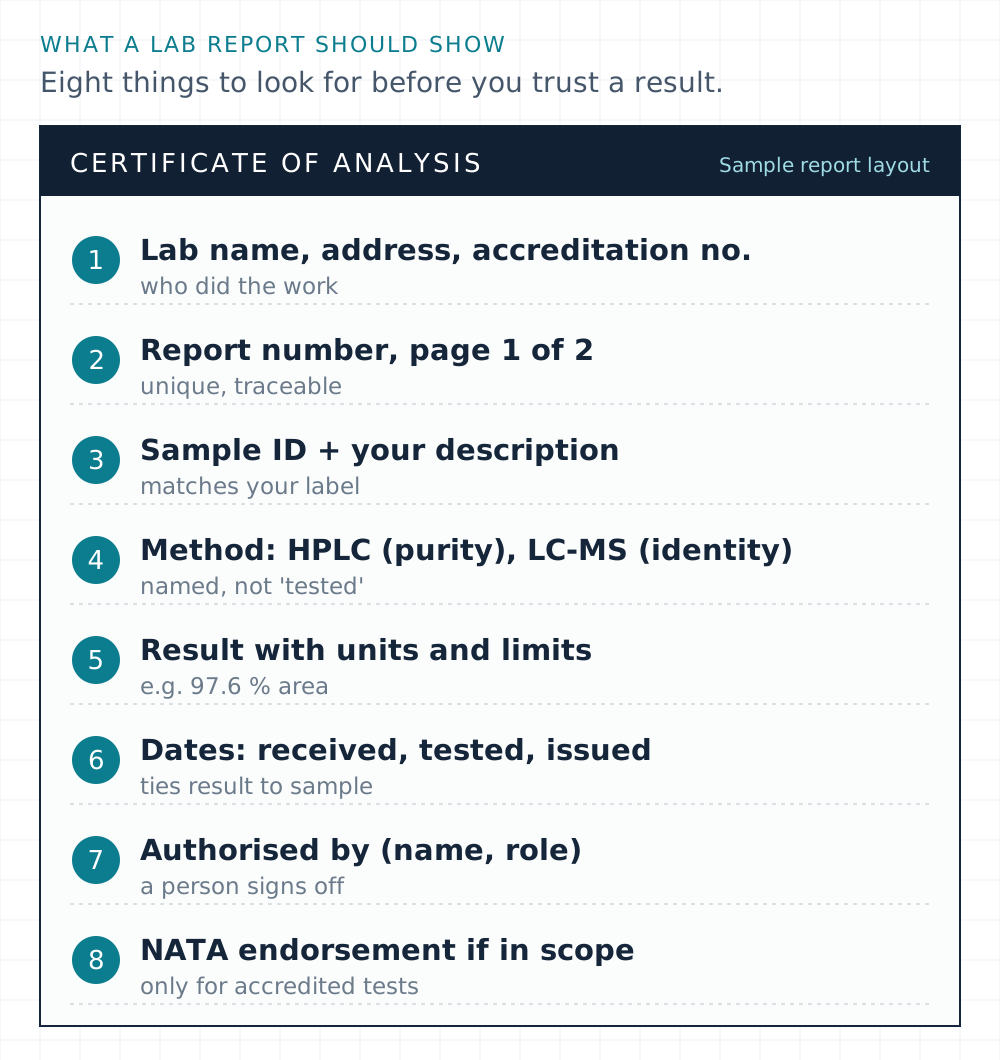
NATA describes test reports as documents that set out the activities performed, the results and, where necessary, the information needed to interpret them (NATA). It also sets some specific rules:
- Preliminary reports may be issued before all tests are complete, but must be checked, authorised and marked as preliminary.
- Subcontracted results must be clearly identified when a report includes tests done by another lab.
- Amendments after issue must be made in a supplement to the report, or by a new report that is identified as such and refers to the original.
Beyond those rules, a useful peptide report names the lab and its accreditation number, gives a unique report number, links the result to your sample ID, names the methods (HPLC for purity, LC-MS or another mass spectrometry method for identity), states results with units, gives the dates and shows who authorised it. A walk-through of how to read a peptide test result from Peptide Testing Australia covers the purity and identity fields in detail.
Questions to ask a lab about accreditation
- What is your NATA accreditation number, and which standard is it against?
- Is the method you will use for my peptide on your scope of accreditation?
- Will my report carry the NATA endorsement, and for which results?
- Will any part of the work be subcontracted to another lab, and will that be shown on the report?
A lab that is accredited for the test should be able to answer all four quickly. If the test is outside its scope, that is not necessarily a problem, but you should know before you rely on the result.
What accreditation does not tell you
Accreditation is about the lab's competence, not the product's status. A NATA-endorsed result on a peptide does not make that peptide approved, legal to supply or safe to use; the TGA decides whether a therapeutic good can be supplied, and says it has not assessed unapproved peptide products for safety, quality or effectiveness (TGA).
Questions
Q.01Is NATA accreditation mandatory for a testing lab?
Not always. NATA says accreditation may be mandated by state or federal regulators, industry bodies, local government requirements or individual customers.
Q.02What is the difference between ISO/IEC 17025 and GMP?
ISO/IEC 17025 accredits a lab's technical competence for specific tests on its scope. GMP and a TGA licence relate to making and releasing therapeutic goods. A lab can hold one, both or neither.
Q.03How do I check a lab's NATA accreditation?
Search NATA's register of accredited organisations by business name or accreditation number, check the status is active, and open the scope to see which tests are covered.
Q.04Does a NATA logo on a certificate mean the peptide is safe?
No. It means the test was within the lab's accredited scope. It says nothing about whether the product is approved or safe to use.