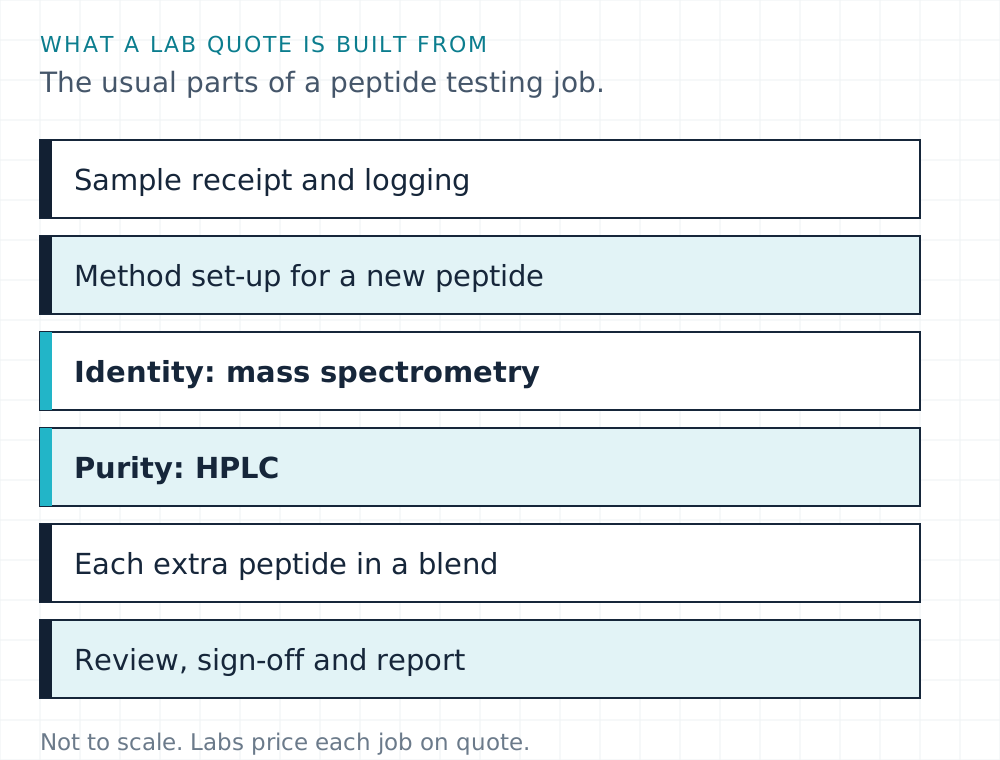
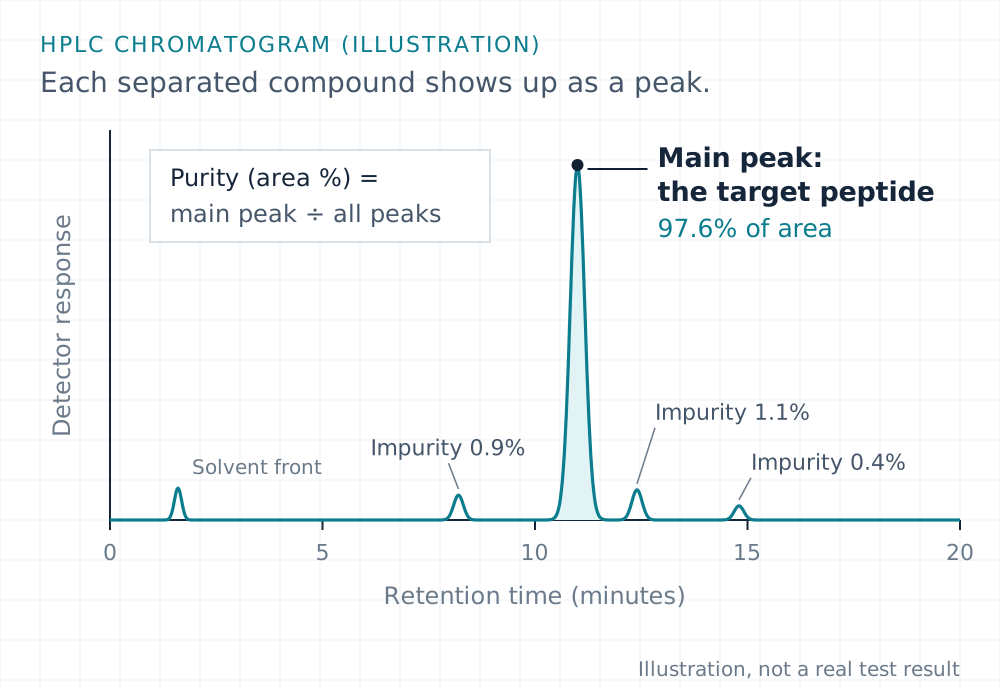
HPLC testing separates the compounds in a dissolved sample and records each one as a peak, so a lab can report what share of the detected material is the peptide it expected. In Australia, peptide HPLC work is run by pharmaceutical testing labs, contract laboratories and university facilities, usually alongside mass spectrometry, which confirms that the main peak is the right peptide.
This report explains how HPLC works, what labs check in a peptide, what the method can miss and which Australian labs describe peptide HPLC or LC-MS work.
What HPLC is
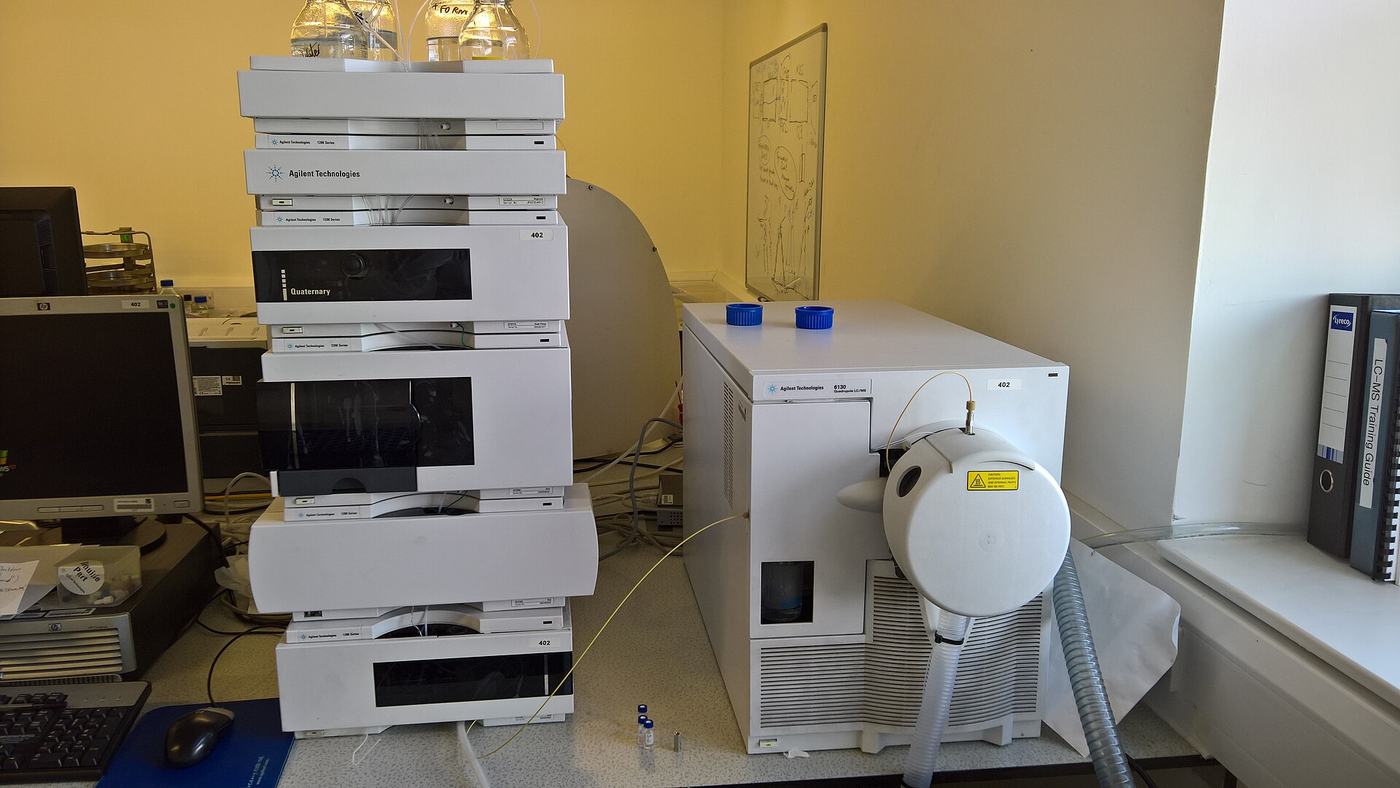
High-performance liquid chromatography is an analytical technique for separating compounds that dissolve in a particular solvent (LibreTexts, UC Davis). A pump pushes a liquid mobile phase through a column packed with a stationary phase. Compounds in the injected sample interact with the column to different degrees, so they leave it at different times, and a detector at the outlet records each one as a peak. The time a compound takes to come out is its retention time.
For peptides, reversed-phase HPLC is the standard mode. Mant and Hodges, whose laboratory has published widely on peptide chromatography, describe reversed-phase chromatography as "the most widely used mode of HPLC for peptide separation" (Mant and Hodges, 2008). In the separations they describe, peaks were detected by UV absorbance at 210 nm.
What labs check in a peptide by HPLC
| Check | What it means | How it appears on a report |
|---|---|---|
| Purity (area %) | Main peak area as a share of all peak area recorded | For example, "Purity (HPLC): 97.6%" |
| Related impurities | By-products of synthesis or breakdown that separate from the main peak | Individual impurity peaks, sometimes listed by retention time |
| Retention time | When the main peak came off the column, compared with a reference standard where one exists | Retention time in minutes |
| Identity (with MS) | Measured mass of the main peak compared with the expected mass | Expected and observed mass, in daltons (Da) |
The purity figure is the one most people look for. It is a share of what the detector recorded, which is why the method, the detector and the chromatogram itself should appear on the report alongside the number.
Where peptide impurities come from
Most peptides today are made by solid-phase peptide synthesis, building the chain one amino acid at a time. A 2014 review of impurities in peptide medicines from Ghent University groups the common problems into synthesis impurities and degradation products (D’Hondt et al., Journal of Pharmaceutical and Biomedical Analysis):
- Deletion and insertion sequences: peptides missing an amino acid or carrying an extra one, linked to inefficient deprotection or excess reagents.
- Racemisation: amino acids converted to their mirror-image form, giving diastereomers.
- Protection adducts and side-chain reactions: chemical groups that should have been removed, or unwanted reactions with synthesis reagents.
- Oxidation and dimers: modified side chains and two or more peptide chains joined together.
- Counter-ions: such as trifluoroacetate left from synthesis or purification.
- Unrelated peptides: contamination the authors link to a lack of appropriate GMP.
- Degradation: breakdown pathways such as β-elimination, diketopiperazine, pyroglutamate and succinimide formation.
Many of these differ from the target peptide by a single residue or a small chemical change, which is what makes them hard to separate and is why a lab's method matters.
What HPLC on its own can miss
- Co-elution. Two compounds that leave the column together look like one peak. Mant and Hodges note that synthesis impurities may be "missing perhaps only one amino acid residue" and that some peptides can co-elute under every set of conditions tried (Mant and Hodges).
- Identity. A single sharp peak says nothing about which peptide it is. A pure sample of the wrong peptide gives a clean chromatogram.
- Material the detector does not respond to. The area percentage covers what produced a signal at the detector, so it is not the same as the full make-up of the vial.
- Microbiology. Sterility and bacterial endotoxin are separate tests.
HPLC-MS: what mass spectrometry adds
LC-MS couples liquid chromatography to a mass spectrometer, so the main peak gets a measured mass that can be compared with the mass expected from the peptide's sequence. If the two match within the method's tolerance, identity is supported; if not, the vial holds something else, however pure. Flinders Analytical says it can determine the molecular weight of synthetic peptides "with high accuracy for quality control", to within 0.2 Da for peptides under 4,000 Da (Flinders Analytical). Tandem mass spectrometry (LC-MS/MS) goes further and can read a sequence: Proteomics International lists de novo peptide sequencing among its services (Proteomics International).
Who runs peptide HPLC and LC-MS in Australia
| Lab | City | What it says it does |
|---|---|---|
| Leeder Analytical | Melbourne | Protein and peptide characterisation; HPLC, LC-MS and GC-MS listed |
| Proteomics International | Perth | Intact mass by LC/MS, de novo sequencing (LC-MS/MS) |
| SGS | Perth office | Peptide mapping, sequencing, molecular weight, to GLP/cGMP |
| Flinders Analytical | Adelaide | Molecular weight of synthetic peptides by MALDI or electrospray MS |
| Chemika | Sydney | Peptide testing of regulated products, commercial clients only |
| Agilex Biolabs | Adelaide, Brisbane | LC-MS/MS bioanalysis of peptide drugs in biological samples |
| BioAgilytix | Melbourne, Brisbane, Sydney | LC/MS bioanalysis of peptide drugs such as GLP-1 receptor agonists |
| Peptide Testing Australia | By post | HPLC purity and mass spectrometry identity for personal samples |
Bioanalysis labs such as Agilex and BioAgilytix use LC-MS to measure peptide drugs in blood for clinical trials. That is a different job from checking the purity of a vial, even though the instruments are similar. Full details for each lab, including who it accepts samples from, are in the lab directory.
Reading an HPLC result
- Check the method is named. "HPLC" or "RP-HPLC", ideally with the detector, rather than a bare "tested".
- Look at the chromatogram. One dominant peak with small neighbours reads differently from several large peaks.
- Read the purity figure as area %. It is a share of the detected peaks.
- Find the identity result. Expected and observed mass should both be shown.
- Tie it to your sample. The report should carry your sample ID, the lab's name and the test date.
For a worked example of a full report, see Peptide Testing Australia's guide to reading a peptide test result, which walks through purity, identity and common red flags.
Questions
Q.01What is an HPLC test?
HPLC (high-performance liquid chromatography) separates the compounds in a dissolved sample and records each as a peak. For a peptide, the main peak's share of total peak area is reported as purity.
Q.02What does "HPLC tested" mean on a label?
It means someone says a sample was analysed by HPLC. Ask which sample, which lab, on what date, and see the report, including the chromatogram and an identity result.
Q.03Is HPLC enough to confirm a peptide?
No. HPLC measures purity but does not identify the peptide. Mass spectrometry, often run as LC-MS, confirms identity by comparing measured and expected mass.
Q.04What is HPLC-MS?
HPLC-MS, or LC-MS, links liquid chromatography to a mass spectrometer, so each separated peak also gets a measured mass. It gives purity and identity information from one run.